
Put commitments in one view
Combine measures, internal work, delivery, installation, company events, time off, and closures in a shared calendar.
See schedule conflicts and overloaded periods before they become a missed install date.
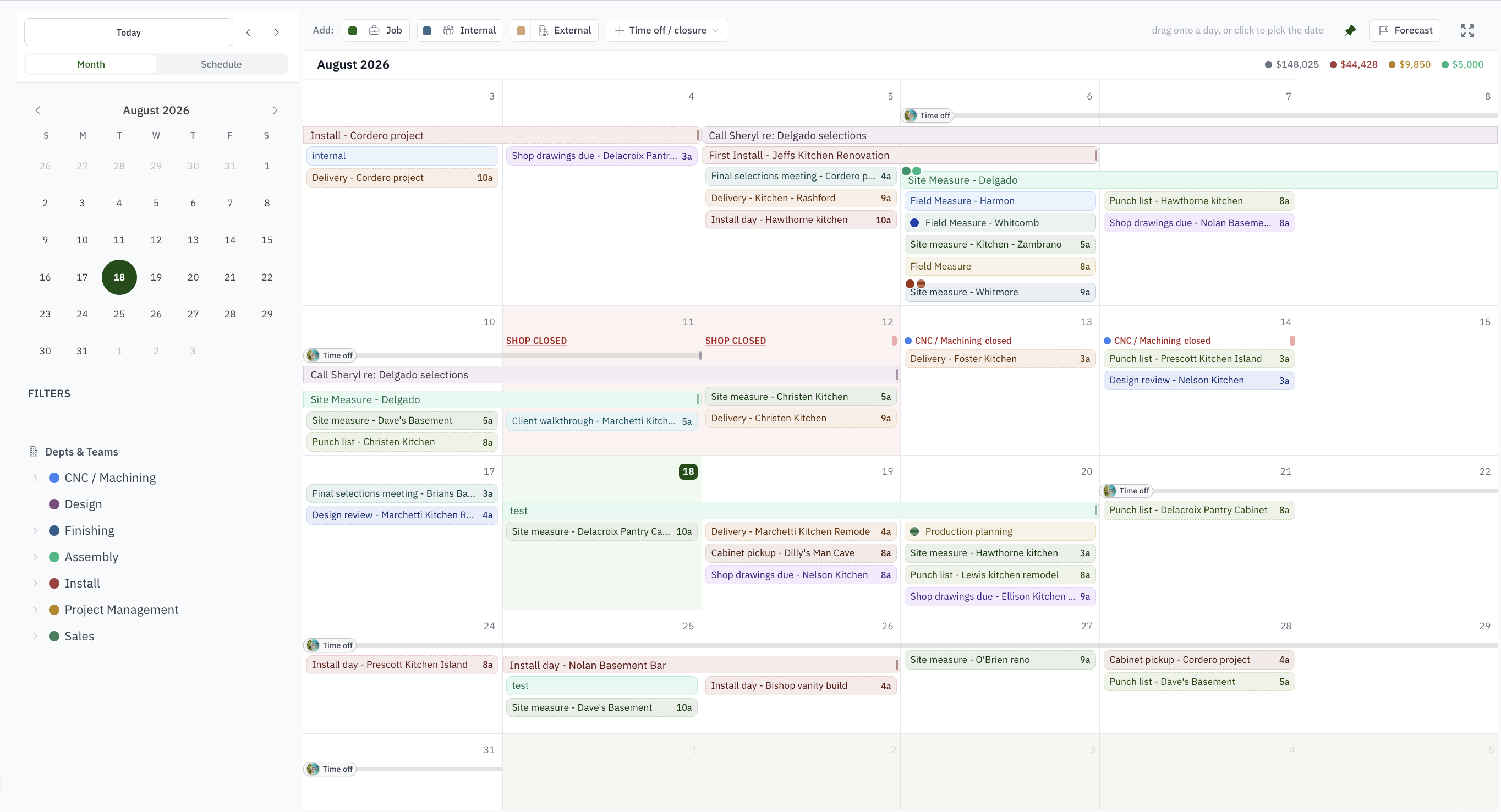
For PMs and production managers scheduling measures, shop work, delivery, and installation.
Sales promises a date without seeing the shop's load.
Production and installation calendars drift apart.
Work moves but downstream teams are updated manually.
Time off and closures compete invisibly with job commitments.

Keep the schedule tied to the drawings, work orders, and people needed to do the work.
Combine measures, internal work, delivery, installation, company events, time off, and closures in a shared calendar.
Use forecasting and capacity views to understand where work is concentrated by date and department.
Adjust work as customer, material, or staffing conditions change while preserving the job context behind the date.
Use recorded labor and completion data to make future scheduling assumptions less dependent on instinct.
A shared schedule becomes more useful when planned work and available department hours can be read together.
The production plan: a backlog lane plus last week, this week and next week. Work orders are dragged into a week, each row shows how much of a department's supply it takes, and a week cannot be committed until the previous one is closed.
On the install planner, a crew calendar for install days. The calendar shows events and install phases; production work stays on the week board so the two never fight.
From actual hours. Past days are what people clocked; future days use each department's configured supply. The board names the bottleneck department rather than guessing.
As an optional capability: a detailed production schedule with a lane per machine or station. Most shops start with the weekly board.
Move the install phase on the planner and the work orders keep their job. The week board then shows what is now late.
No. It is a planning board for people, not finite machine scheduling.